Same slot, different RTP: how to check which version you are playing
Games
Last checked: · CasinoReporters desk
Many slots are released with several certified RTP settings, and the casino, not the player, picks which one goes live. The game title, graphics and features look identical, so the only reliable place to see the difference is the game's own information screen.
On this page9 sections
- Can the same slot really pay back different amounts?
- Who chooses the RTP version, and who certifies it?
- How do you find the RTP inside the game?
- What does 94% instead of 96.5% cost over 1,000 spins at C$1?
- Why can't you feel the difference while playing?
- Does the RTP version matter when you are clearing a bonus?
- What do Ontario's rules say about RTP disclosure?
- How do you use this before choosing a slot?
- Frequently asked questions
Can the same slot really pay back different amounts?
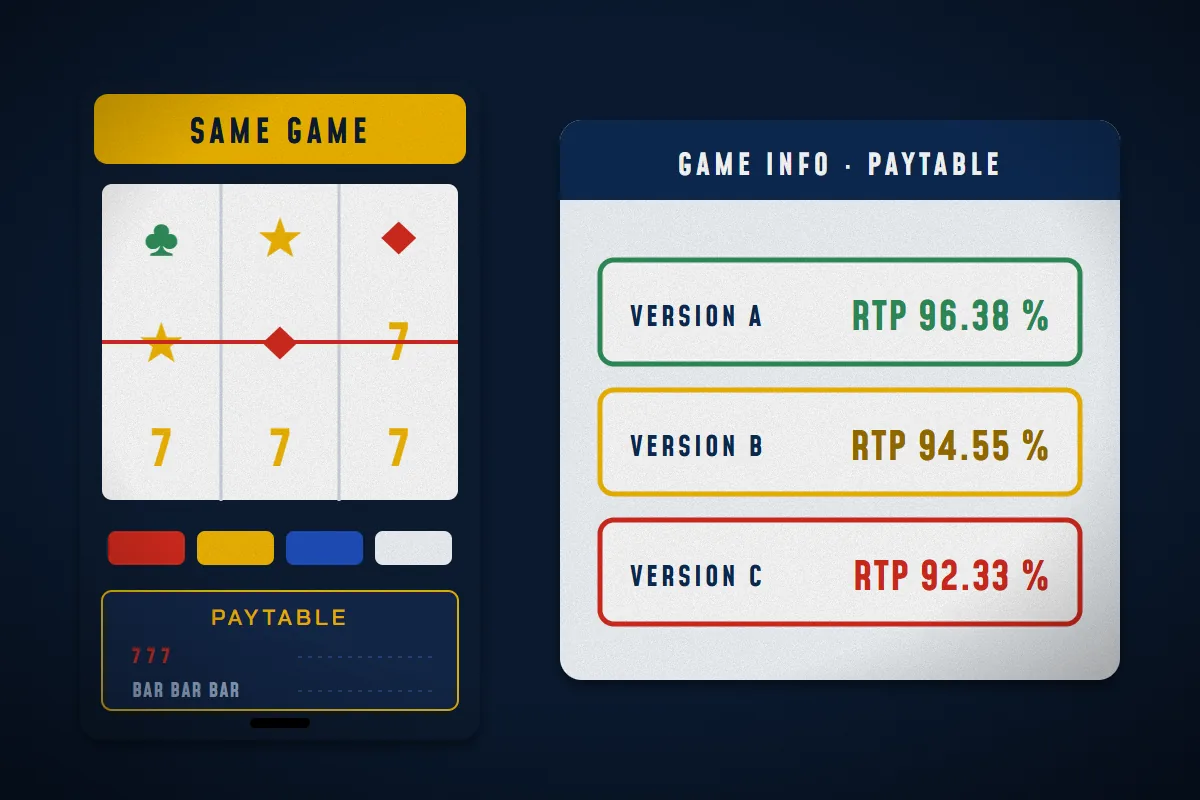
Yes, and some studios say so openly on their own game pages. Hacksaw Gaming's page for Wanted Dead or a Wild lists four RTP figures in its game data: 96.38%, 94.55%, 92.33% and 88.42%. It is one title, one set of reels and features, with four certified long-run payback settings.
BGaming describes the practice in its own guide to RTP: providers often release several RTP versions of the same game, and the casino then chooses which one to run based on margin targets or commercial terms. The same article adds that a different jurisdiction can get a separate build when regulations, taxes or distribution channels lead operators to change settings.
Not every provider publishes its variants. Pragmatic Play's public page for Gates of Olympus, for instance, lists a single RTP of 96.50% and does not mention other versions. A single figure on a provider's marketing page tells you what the game can be configured at, not necessarily what the casino in front of you is running. That is the whole point of this article: check the version you are playing, not the version you read about.
Who chooses the RTP version, and who certifies it?
The operator chooses from the versions the studio has built and had certified. The studio does the maths, an independent testing laboratory checks that each configuration behaves as specified, and the regulator in each market decides which labs it accepts. Play'n GO, for example, names GLI, BMM and Quinel as laboratories that have certified its content.
In Ontario the chain is written into the AGCO's Registrar's Standards for Internet Gaming. Games and related components must be approved by the Registrar or certified by an independent testing laboratory registered by the Registrar before they are provided on a gaming site, and operators must keep track of game enabling, disabling and configuration changes. A different RTP version is therefore not a hidden tweak: it is a separately certified configuration whose use is logged.
What none of this guarantees is that every site runs the highest setting. A lower certified setting is legal. Your protection is disclosure, which is where the info screen comes in.
How do you find the RTP inside the game?
BGaming's advice is to start in the game rather than the casino homepage, because some slots have multiple RTP versions and the in-game information is the most reliable confirmation of the version you are playing. The steps below work on most modern slots.
- Open the slot in real-money mode at the casino you intend to play. A demo on a provider's site or another casino can run a different version.
- Find the information menu. It is usually an "i" icon, a question mark, or a menu icon with three lines near the spin button.
- Open the game rules or help section rather than the paytable alone. The paytable shows symbol values; the rules page normally carries the theoretical return.
- Scroll to the end. RTP is often the last line, worded as theoretical return to player, expected return or RTP. On BGaming slots, for example, you click the "i" icon, then the question mark, and scroll to the Return to Player section.
- Read every figure. Some games state a base-game RTP and a separate figure for a bonus-buy option or feature purchase.
- Note the number and the date. If you return to the game later and the figure has changed, you know the site switched configuration.
If you cannot find any RTP in the rules at all, treat that as information too. In Ontario, the AGCO's standards require comprehensive, accurate and understandable information on the odds of winning, payout odds or returns to players to be easily available before you place a bet.
What does 94% instead of 96.5% cost over 1,000 spins at C$1?
RTP is a long-run average, so the clean way to compare versions is expected loss: total amount wagered multiplied by (1 − RTP). The maths of the bet gives the following for 1,000 spins at C$1, or C$1,000 wagered.
- At 96.5% RTP: C$1,000 × 0.035 = C$35 expected loss.
- At 94% RTP: C$1,000 × 0.060 = C$60 expected loss.
- Difference: C$25 per C$1,000 wagered, or about 71% more expected cost on the lower setting (60 ÷ 35 = 1.71).
Applied to the four published settings of Wanted Dead or a Wild, the spread is wider still:
| RTP setting | House edge | Expected loss per C$1,000 wagered | Average spins from C$100 at C$1 |
|---|---|---|---|
| 96.38% | 3.62% | C$36.20 | about 2,762 |
| 94.55% | 5.45% | C$54.50 | about 1,835 |
| 92.33% | 7.67% | C$76.70 | about 1,304 |
| 88.42% | 11.58% | C$115.80 | about 864 |
The last column answers a question players actually ask: how long C$100 lasts. Because winnings are re-staked, a C$100 balance at C$1 a spin supports on average C$100 ÷ house edge in total wagers. At 96.5% that is about 2,857 spins; at 94% it is about 1,667. The game looks the same, but on the lower setting your money lasts roughly 40% fewer spins on average.
Why can't you feel the difference while playing?
Over a session of a few hundred spins, the swing from the game's volatility is far larger than the gap between two RTP settings. A single bonus round can return more than an entire session's expected loss, or never arrive at all. That is why a lower setting is invisible in practice and only shows up over thousands of spins, or across many players.
It is also why the tactics people try to read the version from results do not work. A hot session on a 94% build and a cold one on a 96.5% build are both normal. The only reliable test is the number in the rules screen, which is set in the certified configuration and does not depend on your luck.
Does the RTP version matter when you are clearing a bonus?
It matters more there than anywhere else, because wagering requirements are expressed in amount wagered, which is exactly the base of the expected-loss formula. If a bonus requires C$1,000 of play, the cost of clearing it is roughly C$35 at 96.5% and C$60 at 94%, before the bonus amount is counted. On a 35× requirement, the difference grows with the multiple.
Here is the working for a C$50 bonus with a 35× wagering requirement on the bonus amount, played entirely on a slot that counts 100%:
- Required wagering: C$50 × 35 = C$1,750.
- Expected cost at 96.5%: C$1,750 × 0.035 = C$61.25, which is more than the C$50 bonus itself.
- Expected cost at 94%: C$1,750 × 0.060 = C$105.00, more than twice the bonus.
- Difference between the two versions: C$43.75 on the same offer and the same game title.
On the higher setting, the bonus already costs more to clear on average than it is worth; on the lower setting the gap more than doubles. A version check takes seconds and can change whether an offer is worth taking at all.
Bonus terms sometimes restrict which games count and how much, so check the game weighting before you start. Our casino bonus guide explains the main terms, and the wagering requirement cost calculator works through the same maths for a full offer.
What do Ontario's rules say about RTP disclosure?
The AGCO's Registrar's Standards for Internet Gaming do not prescribe a minimum RTP figure in the provisions reviewed for this article. They work through disclosure and certification instead:
- Before you bet, comprehensive and accurate information explaining the terms governing play must be easily available, including information on the odds of winning, payout odds or returns to players.
- Information provided before and during play shall not mislead players or misrepresent games.
- Games must be approved by the Registrar or certified by a registered independent testing laboratory before use, and configuration changes must be tracked.
In practice, that means a registered Ontario site has to show you the return of the version it runs, and has to run a version that was certified. It does not have to run the highest version a studio offers. Outside Ontario's open market, provincial sites set their own game libraries, and offshore sites answer to whichever foreign licence they hold, if any. Our Ontario casino overview explains how to confirm a site is registered.
How do you use this before choosing a slot?
Make the info screen part of the routine, the same way you check the bet size. Compare the RTP of the same title at two sites if you play at both. Prefer the higher version when the game is otherwise the same, especially when you are wagering a bonus. And if a game hides its return or shows a figure well below what the studio publishes as its top setting, choose another title from the slots section; there is no shortage of games that state their numbers plainly.
Where you can play
 PowBet Casino300% up to C$4,500 + 300 free spinsnot registered with iGaming OntarioVisit casino
 N1Bet Casino300% up to C$10,000 + 200 free spins on the first four deposits50x wagering on the bonusVisit casino
 SlotsMafia Casino100% up to C$3,000 + 200 free spinsbonus needs a C$45 depositVisit casino
Advertising · not shown to Ontario residents · 19+ · Operator T&Cs apply · Play responsibly
Frequently asked questions
Why does the same slot show different RTP at different casinos?
Studios often release several certified RTP versions of a game, and each casino chooses which one to run. BGaming describes this practice directly, and Hacksaw Gaming lists four RTP figures for Wanted Dead or a Wild on its own game page.
Where is the RTP shown in a slot?
Open the game's information or help menu, usually an "i" or question-mark icon, and go to the rules section. The theoretical RTP is normally near the end, sometimes with a separate figure for a feature-buy option.
How much more does a 94% slot cost than a 96.5% slot?
Over C$1,000 wagered, the expected loss is C$60 at 94% and C$35 at 96.5%, a C$25 difference. Over a short session, volatility hides that gap, but over thousands of spins it shows up.
Is a lower RTP version legal in Ontario?
Yes, if it is a certified configuration. The AGCO's standards require games to be approved or certified by a registered testing laboratory, require accurate information on returns to be easily available, and prohibit misleading game information.
Can I tell which version I am playing from my results?
No. Short-term results are dominated by volatility, so a winning session on a low setting and a losing session on a high one are both normal. Only the figure in the game's rules screen tells you the version.
Sources
How we are fundedIf you sign up through a link, we may earn a commission; it has no effect on the review.19+Help: ConnexOntario 1-866-531-2600
Read next
 LotteryWinning a big lottery prize in Canada: claim deadlines, publicity, anonymityWon Lotto Max or Lotto 6/49 in Canada? Claim deadlines by province, what OLG, BCLC, Loto-Québec, WCLC and ALC publish about winners.
 BonusesThe real cost of a wagering requirement, worked out in Canadian dollarsWhat a wagering requirement costs in C$: turnover times house edge, bonus-only vs deposit+bonus, game weighting.
 BonusesThe maximum bet rule: how one oversized spin can void a bonusThe maximum bet rule in casino bonuses: how caps like C$5 work, how they meet bonus buys, gamble features and auto-play.